

Featured in Professional Electrician, January 2026

Joshua Hammerton, co-founder of Enkin and former electrician, provides some technical insight for the modern professional.
The lighting industry is evolving faster than ever. Traditional control systems are being replaced by intelligent, connected networks that not only enhance user comfort but also help achieve energy efficiency and regulatory compliance.
For electricians, understanding the technology and standards behind smart dimming is now essential to professional practice.
Smarter systems, practical solutions
Smart lighting has moved beyond novelty. Customers now expect lighting that integrates seamlessly with voice assistants, mobile Apps and home automation systems.
Whether in residential, commercial or hospitality environments, demand is rising for reliable, flexible and energy-efficient lighting controls that are simple to install and maintain. The challenge, however, lies in balancing sophistication with practicality.
Many smart systems remain complex to configure, difficult to retrofit, or incompatible with existing wiring arrangements. However, products like Enkin’s ZDM150 Inline Zigbee Smart Dimmer represent a new generation of solutions designed with electricians in mind. This dimmer module is compact, robust and compliant with the latest standards.
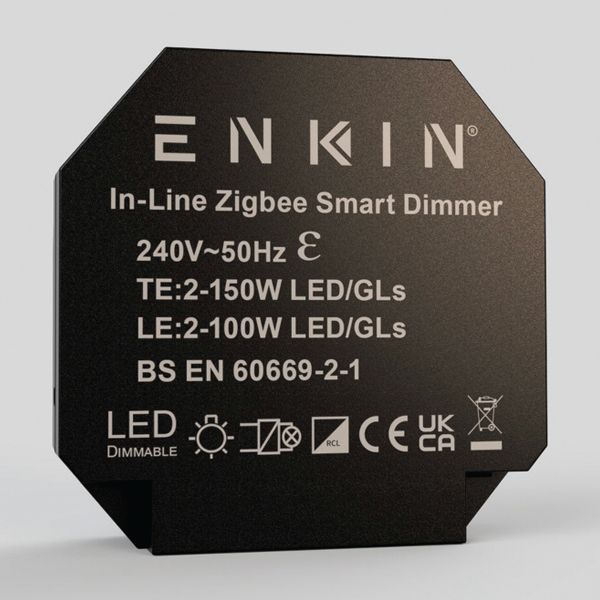
But, beyond the product itself lies a broader discussion: What controls the design and installation of smart dimming systems in the UK?
The standards behind smart dimming
As lighting control systems become more intelligent and integrated, compliance with safety, installation, and performance standards is vital.
The following framework guides the use and installation of smart dimming systems:
- BS EN 60669-2-1 – Governs the design and performance of electronic switches, including dimmers, used in fixed installations for residential and commercial environments.
- BS EN 55015 and BS EN 61000 series – Define electromagnetic compatibility (EMC) limits and immunity. While not listed on product datasheets, Enkin devices are CE/UKCA marked and designed to meet these EMC expectations.
- BS 7671 (IET Wiring Regulations) – Enkin dimmers are suitable for use in installations compliant with BS 7671, especially Sections 559 (lighting installations) and 715 (ELV lighting).
- BS EN 15193-1:2017 – While not a direct product certification, Enkin dimming modules contribute to energy-efficient lighting control in buildings assessed under this standard.
- Building Regulations Part L – Enkin’s smart dimmers support energy-efficient lighting strategies, aiding compliance in both new and retrofit projects.
Adhering to these standards ensures that smart dimmers not only operate reliably but integrate safely into lighting systems without compromising electrical safety or causing interference with other devices.
Smart connectivity and system compatibility
Modern lighting systems depend on communication procedures that determine how devices interact. For electricians, understanding these procedures helps ensure correct design and troubleshooting.
Zigbee for example, operates as a self-healing mesh network, so every connected device strengthens the system, enhancing reliability and range. This differs from Bluetooth-based solutions, which generally use point-to-point connections offering less flexibility for future growth.
Other relevant communication standards include:
- DALI-2 (IEC 62386): Widely used in commercial lighting control for digital communication between luminaires and controllers.
- Matter and Zigbee 3.0 (CSA Alliance): Open frameworks designed to promote interoperability between different manufacturers and ecosystems.
Understanding these frameworks helps professionals design lighting systems that remain adaptable and future-proof as the market continues to evolve.
Energy efficiency and regulation
Smart dimming plays a direct role in meeting energy efficiency requirements under Building Regulations. By enabling automated control, scene setting and daylight or motion-sensing control, smart dimmers reduce unnecessary energy consumption and extend lamp life.
Installation and practical considerations
Successful integration of smart dimming relies on thorough installation practices. Electricians should confirm:
- Load compatibility: Confirm the dimmer supports the connected lamp type and total wattage
- Neutral availability: Unlike Enkin dimmers which don’t need neutrals, some dimmers require a neutral conductor; others are designed for two-wire systems.
- Space constraints: Compact module designs, such as inline or behind-switch units, simplify retrofit into standard back boxes
- Manual control: Retaining local retractive or two-way switch functionality ensures control continuity during network outages
- Commissioning: Secure pairing via Apps or hubs must follow manufacturer guidance to avoid interference and connectivity issues
Attention to these details can significantly reduce call-backs and improve user satisfaction.
The electrician’s role in the smart era
Electricians are no longer just installers – they now bridge the gap between electrical safety, digital connectivity and user experience. As clients increasingly expect voice-activated and App-controlled lighting, professional electricians who understand the governing standards, procedures and design considerations will be able to lead these conversations.
Smart dimming isn’t just about convenience; it’s about control, efficiency and compliance.